Somerset Council can influence local energy consumption and generation, especially through planning policies in the Local Plan. I have called for work on this since 2019 when Somerset West and Taunton Council was established, and continued to push for it with the creation of the new Somerset Council.
Work was finally started in 2023 when contractors Regen were appointed to prepare a Somerset Energy Investment Plan. A Task and Finish Group was established to help shape and influence the plan. I was one of six councillors volunteering for this group and then selected as chair at the first meeting.
The task and finish group met from October 2023 to February 2024, and established a constructive dialogue with Regen on the plan’s content, recommendations and targets.
The completed Energy Plan and an accompanying Task and Finish Group report were presented to Climate and Place Scrutiny Committee on 20 March 2024 (item 57). The committee unanimously agreed to accept the group’s recommendations to the Executive, which will be the next step to be taken along the democratic path to adopt and implement the plan.
Net zero pathway
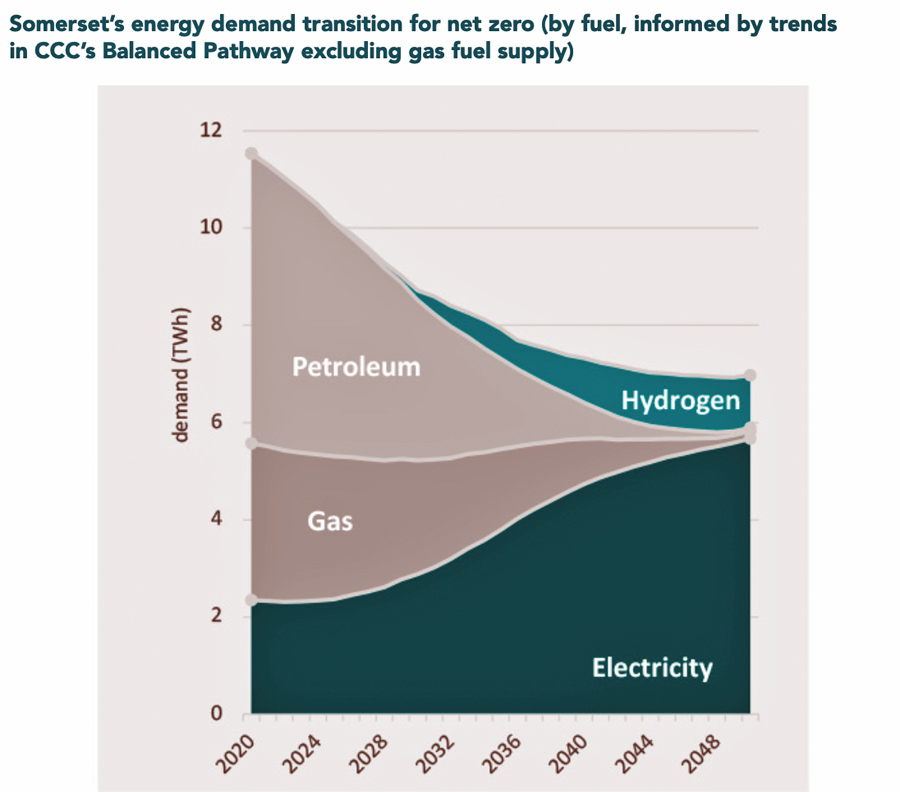
The Somerset Energy Investment Plan sets out an important framework for the development of the energy system in Somerset. It focuses on how Somerset Council can assist in addressing energy needs and the climate emergency by moving towards a net zero future for greenhouse gas emissions. This entails moving away from fossil fuels and instead using clean renewable sources to supply our energy needs, as shown in the chart below.
Key elements of the framework are:
- Reducing demand through energy efficiency, insulating buildings and technology shifts, such as electric vehicles and heat pumps.
- Electrification of energy supply through renewable and low carbon energy sources, both local and national.
- Support for the right infrastructure, flexibility and storage assets.
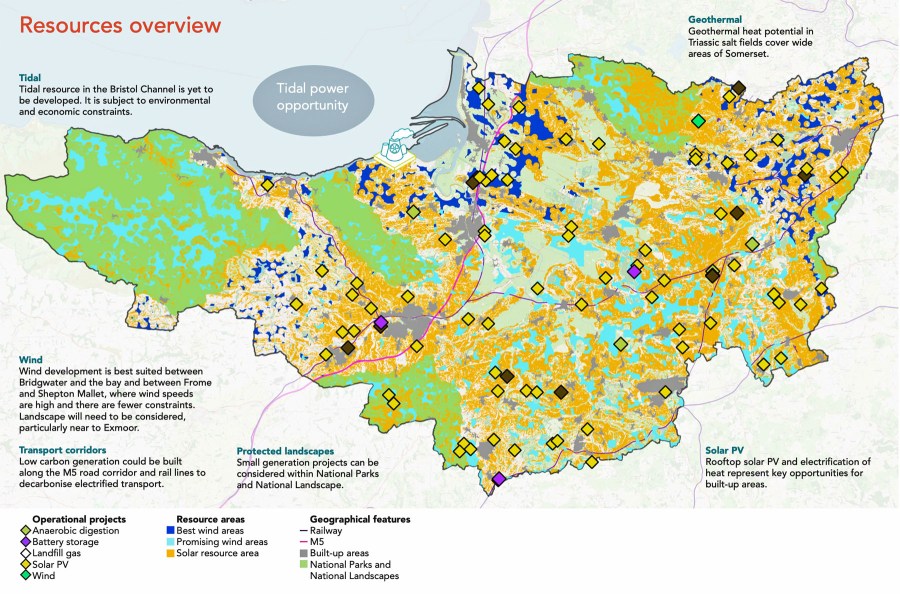
Regen’s work included an assessment of constraints and opportunities for the generation of renewable energy resources in Somerset, which will be an important contributor to Somerset’s new Local Plan. The map below (click to view at higher resolution) shows the best opportunities for renewable energy generation.
Due to a financial crisis, the council may only be able to take on the role of enabler and co-ordinator, rather than lead investor in new generation.
Key actions
The Task and Finish Group endorsed key themes and actions in the Regen plan, especially the following:
- Install solar or wind power at ten council sites with good potential for local generation (p. 53).
- Develop a land use framework to underpin the development of robust Local Plan policies on renewables (p. 58).
- Encourage local hubs to develop local skills for low carbon heating and to retrofit insulation (p. 66).
- A Net Zero Heat Village trial to demonstrate how to deliver zero carbon heat in an off-gas rural village (p. 70).
- Engage with the new Regional Energy Strategic Planner to influence investment in the electricity network (pp. 75-77).
The Task and Finish Group highlighted several important issues raised in the Regen plan.
Electricity grid constraints on the transmission network are a big brake and delay on the development of local renewable generation. This could also restrict the roll-out of electric vehicle charging infrastructure and prevent the early adoption of heat pumps in some new housing estates.
The Council’s new Local Plan (land use planning policies) is a big opportunity to advance progress towards net zero, but one that is significantly delayed by the time that will be taken for the plan’s production, consultation and adoption. It’s also a missed opportunity for development approved before new net zero policies are adopted and for new energy infrastructure that cannot proceed before new policies are in place.
Large-scale solar, wind and energy storage projects may gain more support and give greater local benefits where there is early involvement of local communities and profits shared through on-going funding to communities.
Targets
Targets were an important discussion point and carefully considered. The Regen plan has several targets: for homes to achieve an EPC (Energy Performance Certificate) of C or above, on take-up of heat pumps, switching to electric vehicles, installing solar photovoltaic (PV) panels on roofs, and renewable generation from solar farms and wind turbines.
All these targets are challenging and some will need greater support from government, especially on home energy performance.
There is a problem with the target for homes to achieve EPC C by 2035 as Energy Performance Certificates do not currently provide a clear guide for householders to make a full contribution to net zero. It is also hoped that local renewable energy generation may be able to contribute more than the 45% target suggested. Therefore, these targets will need to be subject to future review. For now, they should be sufficient to encourage and allow good progress towards net zero, although it is important to be aware that higher home insulation standards may be needed to achieve net zero.
Guides for achieving net zero in the energy performance of buildings are provided by LETI for new builds and for retrofit of existing homes or by the similar Net Zero Carbon Toolkit that was adopted by Somerset West and Taunton Council. These net zero guides adopt a whole house approach to insulation which is important to ensuring high performance and for avoiding problems, such as damp and mould, that can arise from piecemeal insulation measures, especially in older properties.
Effective insulation to a high standard should be considered when installing a heat pump and ideally before (called a fabric first approach). As well as avoiding the risk of damp and mould problems, a whole house (fabric first) approach reduces energy demand (saving on bills) and allows heat pumps to be installed at the correct size, which can then operate effectively and efficiently.
Households need good and reliable advice and information on insulation and on switching to a heat pump. It may need to be decided how far to go in retrofitting insulation to homes, which should be considered when switching to a heat pump. Wall insulation can be the most disruptive and costly energy efficiency measure for older houses with solid walls.
Insulation should be viewed as a long-term investment with an initial cost that is paid back over time in savings on energy bills.
Somerset Council will needs to consider how it can best assist and work with others to improve the energy performance of Somerset homes. This can build on several initiatives and programmes already underway, some with government or energy supplier funding.
High targets for more solar generation in the Regen report are likely to be challenging, due to grid constraints on solar farms and the higher costs involved in rooftop installation.
The number of rooftop solar PV installed was much higher in the past when a feed-in tariff was available. The payback from solar PV should continue to slowly improve again, as the cost of panels continues to fall, while generation performance increases, and with improved prices paid for solar power exported to the grid.
Special community offers for the bulk installation of solar PV panels to households in an area could assist in increasing take up. There have been successful schemes already for this in parts of Somerset, including Frome, Wedmore and the Wiveliscombe area. This could be extended to new areas, supported by local community organisations and involving local solar installation businesses.
There are few wind turbines at present in Somerset but there are many areas with high wind speeds that could be suited to their siting, including by farmers, looking for diversification opportunities, and other landowners. First, planning policy obstacles need to be addressed and, in some areas, grid constraints. Once there is more experience of installing wind turbines in Somerset, the future contribution of this low-cost electricity source could be reviewed and, possibly, increased.
Next steps
Somerset Council now needs to consider the Energy Plan internally and with external stakeholders and partners. The Council should further prioritise the actions recommended, draw up internal action plans with resources and funding provided.
The Task and Finish Group recommended that the Executive progress the following:
- Appraisals for solar or wind power installations at ten council sites with considerable potential for local generation, as well as opportunities, that benefit all parties, for Virtual Power Purchase Agreements and for private wires to high-energy users.
- A land use framework to underpin the development of robust Local Plan policies on renewable energy generation.
- Support for local hubs to develop local skills for low carbon heating and retrofit installations in Somerset homes and commercial buildings.
- Implement a Net Zero Heat Village trial to demonstrate how to deliver zero carbon heat in an off-gas rural village, possibly by working with a willing local community or community group.
- Council engagement with the new Regional Energy Strategic Planner to influence investment in the electricity network to overcome current grid constraints.
It was also recommended that the Executive and relevant Lead Members continue current work to:
- Decarbonise council buildings, such as offices and leisure centres.
- Decarbonise the council’s housing stock, including by working with other social housing providers.
- Include robust planning policy in the new Local Plan to support the development of high-quality large-scale solar, wind and energy storage projects and to support and deliver zero carbon homes, including energy improvements for historic and listed buildings. Early steps should be taken to develop and give weight to these policies.
- New Local Plan policies should encourage the early involvement of local communities in large-scale projects and for profits to be shared through on-going funding to local communities.
- Consideration should be given to new planning policies that require current and future small-scale electricity generation (that uses fossil fuels) to be powered from the grid instead, from battery storage or from a clean fuel source, such as green hydrogen. Consideration should also be given to requiring the capture of greenhouse gases from EFW plants.
- Consider how to improve the energy performance of Somerset homes, as discussed above.
- Develop public charging infrastructure for electric vehicles.
- Improve and electrify bus services.
- Prepare a transport plan that promotes public transport and active travel (cycling and walking).
Climate and Place Scrutiny Committee also requested future reports from officers and external partners so that further consideration can be given to the following:
- Progress on the Local Plan and, in particular, opportunities for early weight to be given for policies to support large-scale solar, wind and energy storage projects, the delivery of zero carbon homes, and energy improvements for historic and listed buildings.
- A supplementary planning document on the approach to energy efficiency in listed buildings, along lines already put in place by Bath & North East Somerset Council.
- A heat hierarchy policy like Bristol City Council’s BCS14.
- Constraints on the electricity distribution grid and work, including time scales to overcome these, both by network providers and by the new Regional Energy Strategic Planner. Also the potential for local generators to sell to local users.
- The work of community energy groups in Somerset and their interest in expanding this further.
- Economic development opportunities from local renewable energy generation and local hubs to develop skills for low carbon heating and installing insulation in Somerset homes and commercial buildings.
Climate emergency
The slow progress on putting green energy policies in place for Somerset is deeply frustrating, but not surprising given the weakness of the climate emergency strategy originally adopted by Somerset Councils at the time and the disruption of moving to a unitary Somerset Council.
Despite its financial difficulties, the new Somerset Council now needs to advance the recommendations of the new Somerset Energy Investment Plan as quickly as possible. I will continue to do my best to strongly push it along.
Somerset Energy Investment Plan
- Scrutiny committee report on Task and Finish Group
- Task and Finish Group report and recommendations
- Somerset Energy Investment Plan – produced for Somerset Council by Regen
Discover more from A GREEN VIEW for Wiveliscombe and Upper Tone
Subscribe to get the latest posts sent to your email.

