After years of service decline, better bus services are on the way for Milverton, Wiveliscombe and those on routes to Taunton and Wellington.
Somerset Council received additional Bus Service Improvement Plan (BSIP) funding for 2025/26 of £3.3m for capital and £2.9m for revenue spending. Some of this is being used by Somerset Council to support the following service improvements in Upper Tone from 22 April 2025:
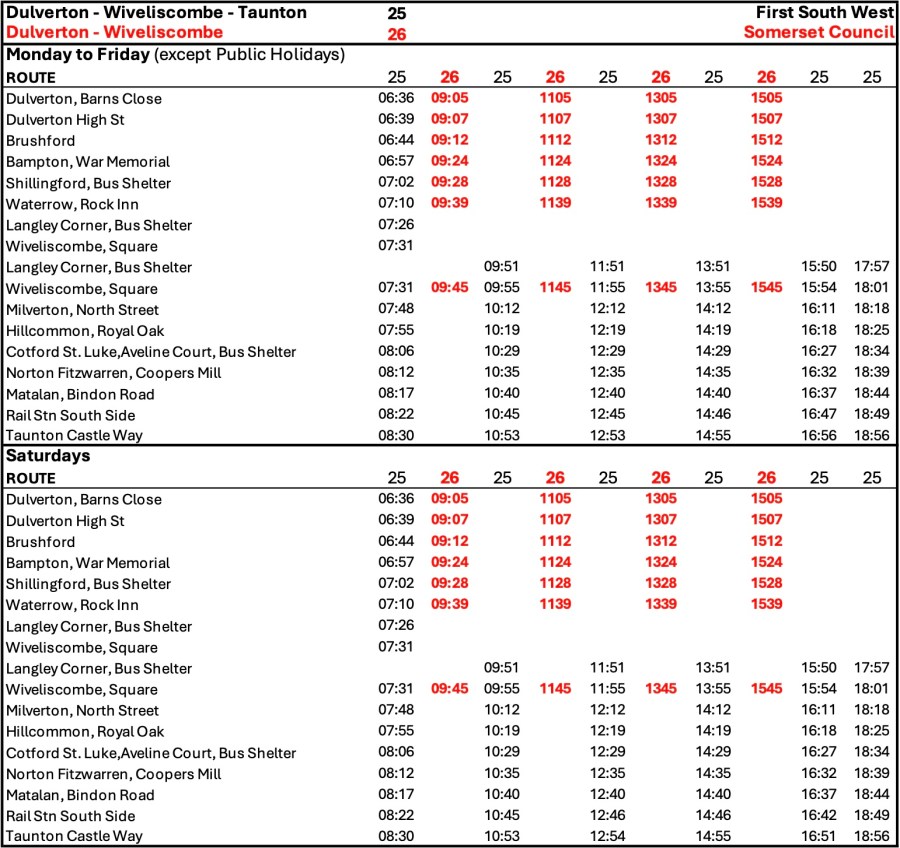
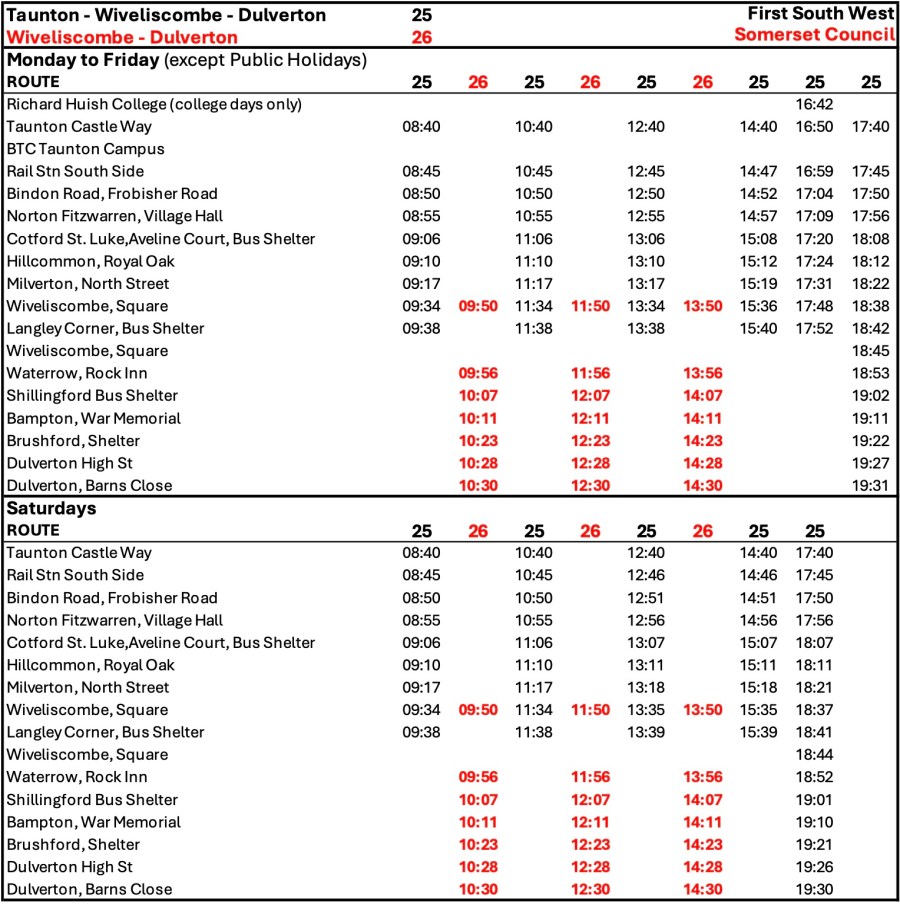
Route 25 – The route will be split with the new 25 from 22 April serving Wiveliscombe to Taunton. It will only extend to Dulverton on the first and last services of the day. There will be a new timetable with smaller service gaps, better timings and some leeway to allow better reliability. The service will continue to be operated by First Bus.
Route 26 – A new route (previously covered by the 25) serving Dulverton to Wiveliscombe, which will be operated by Somerset Council using a minibus with 14-23 seats.
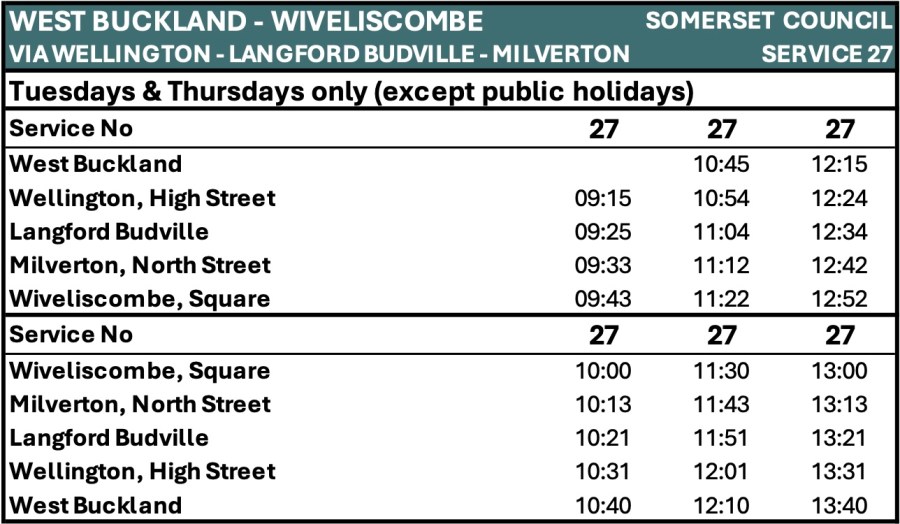
Route 27 – A restored route between Wiveliscombe and Wellington, which will also cover West Buckland and have stops at Langford Budville and Milverton, including Butts Way and Spring Grove Cross (hail to request). This will be operated as a trial by Somerset Council using a minibus with 14-23 seats on Tuesdays and Thursdays (except bank holidays).
New timetables for the 25, 26 and 27 from 22 April 2025 are given below.
Other bus service improvements during 2025/26 will include:
Richard Huish College stop for the 25 bus at 16:42 on college days only.
Digital Slinky (on demand) buses for villages not on the main bus routes will allow booking up to an hour before travel from this summer (currently Slinky needs to be booked 24 hours before). Book using new online app or by phone. The Slinky service has already changed to allow booking by those with their own cars and not just those without.
Wivey Link continues to provide community transport for anyone who, for whatever reason, has no access to public or private transport and to those residents who are chronically sick or disabled. Wivey Link operates weekdays, except bank holidays, from approximately 9am to 6pm. You need to register and pre-book in advance.
Calls for new bus services pays off
The service improvements follow strong calls for better buses serving the Wivey area over the last 18 months.
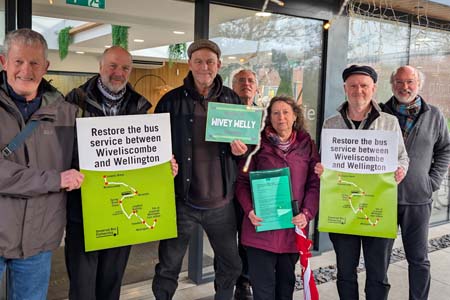
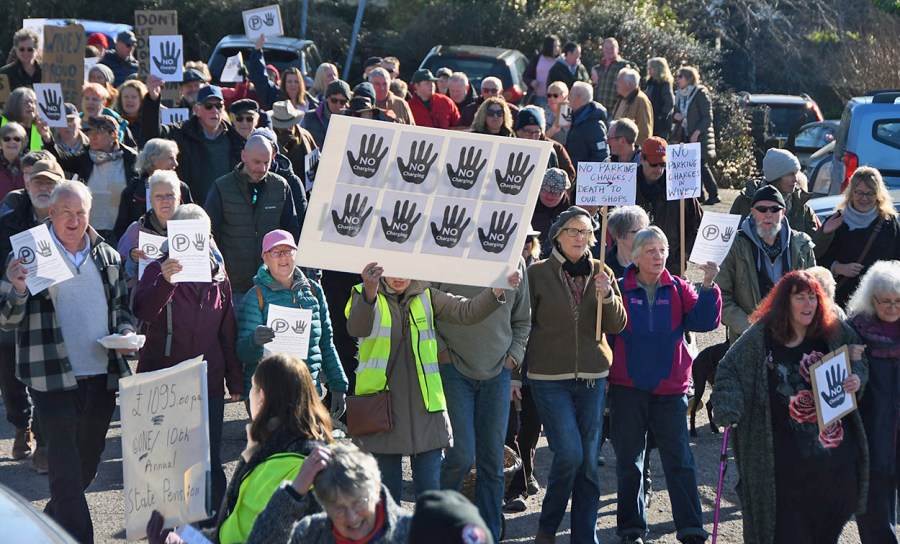
The Wivey-Welly Bus User Group has campaigned for better and more reliable buses. This included a campaign to restore a service between Wiveliscombe and Wellington, with a petition signed by 1,360 people presented to Somerset Council on 18 December 2024 (photo taken outside the full council meeting venue above). This local campaign was also supported by Somerset Bus Partnership.
In addition, a Public and Community Transport Working Group was established in April 2024 by the Local Community Network for Wellington and Wiveliscombe, which I chaired. The group consists of representatives from parish and town councils, local bus user groups, Wiveliscombe Area Partnership and Transition Town Wellington. We submitted recommendations and ideas for service improvements that have largely been adopted with the bus service changes to be made this year.
New Timetables
New timetables from TUESDAY, 22 APRIL 2025 are planned to be as follows:
Click on timetables to view and download a PDF copy.
The 27 can be used on a hail and ride basis, which will serve all request stops and anywhere else where it’s safe to stop along the rural parts of the route (but not in town). Ensure the driver knows by clearly putting your hand out to be picked up and ask to be dropped off. Request stops on the route will include Butts Way in Milverton and Lidl in Wellington. It will need to be hailed at Spring Grove Cross when travelling between Milverton and Langford Budville.
The new 27 route is being operated as a trial during 2025/26. If well used and funding remains, it should be retained. Amongst other changes, I have asked if there could be another return service from Wellington in the afternoon and suggested extending the route to include Fitzhead and Halse. The timetable is now registered and fixed from 22 April, but it may be possible to consider improvements when timetable changes are next considered from September. Again, showing good use and potential demand will be important.
The minibuses used on the 26 and 27 will normally have a low floor and be accessible to wheelchair users, but, unfortunately, this cannot be guaranteed. Bus stops also need to allow accessible use and some are not suitable at present, but this is being worked on. It is hoped more accessible stops will be established in the near future, including in Milverton, where this is currently a problem.
Transformation and workforce reduction programmes were agreed by the Executive in April 2024, with the initial aim of cutting officer posts by 20-26% (a loss of over 1,000). This restructure has been completed over the last year, starting with an invitation for council officers to apply for voluntary redundancy, then consultation and decisions on a new organisation structure, and finally a compulsory redundancy programme.
The final number of jobs and posts lost remains hard to pin down. It looks to be over 700, with over 200 approved for voluntary redundancy and 555 posts agreed for removal in February 2025, which I voted against as some of the cuts are going too far. In addition, many good officers have simply left for better opportunities elsewhere.
Cuts to the workforce had to be made, but it’s been a difficult and sad time as this has all unfolded. The staff reduction will allow an annual saving to the council of £34m. The number leaving and saving made is twice that planned for Somerset Council to achieve when established as a new unitary council in April 2023.
The new council structure reduces the number of directorates from 7 to 4, which are now: children and family services; adult social care (including housing); community, place and economy (including climate change, planning and transport); and strategy, transformation and resources (including democratic services, finance and public health).
A productivity plan was published in July 2024, which highlights actions that are being taking to improve efficiency and reduce waste at Somerset Council, as well outlining barriers the council faces.
Exceptional financial support and more needed to balance budgets
To set a balanced budget, Somerset Council has needed government approval for exceptional financial support in both 2024/25 (when a Conservative government) and 2025/26 (now Labour).
The government controls Council Tax in England by setting an annual cap on how much it can be increased. For 2024/25, Somerset Council requested an increase in Council Tax of 5% above the cap, which was not agreed and so the council could only increase Council Tax by the cap of 5%. For 2025/26, Somerset Council has been allowed an increase in Council Tax of 2.5% above the cap, so a total of 7.5%. The extra 2.5% will bring in another £9.2m every year to the council.
For both years, Somerset Council has been allowed further exceptional support through what is known as a capitalisation direction, which allows the council to sell assets, such as property, or to borrow funds just to pay day-to-day operating costs during the year. This allows a budget gap to be closed but just moves the same gap on to the next year. Capitalisation only buys time, literally.
In 2024/25, £77m of council costs were allowed to be met by capitalisation, with £37m for operating costs and £40m allowed for transformation and redundancy costs.
In 2025/26, £43m of council costs have been allowed to be met by capitalisation, which will probably be achieved by selling more council property.
The budget for 2024/25 also required savings of £35m to be made through efficiency measures, increased charges and service changes or cuts (detailed in appendix 7 of report to full council on February 2024), as well as using £37m from reserves. The combination of capitalisation, savings and use of reserves allowed a balanced budget to be set, so that income from all sources could cover the council’s expected costs.
However, the council’s Medium-Term Financial Forecast in February 2024 identified a budget gap returning, which was expected to grow to close to £200m over the following five years. The main cause being increasing costs for adults’ and children’s social care.
During 2024/25, additional strict financial control measures were implemented which resulted in an underspend for the year expected to be about £20m. This will allow the use of reserves to be reduced to £19m (from the £37m that had been budgeted).
The government is also allowing £20m of capitalisation costs to be carried forward from 2024/25 into 2025/26 to cover transformation and redundancy costs which have not yet been incurred.
In both 2024/25 and 2025/26, it is expected that the council will be able to sell sufficient property to cover capitalisation costs. Non-operational assets to be sold were approved by the Executive in August 2024, although more may now be needed.
The original on-going savings predicted from merging previous councils to form a unitary Somerset Council were £18.5m, which have been delivered as part of the staff reduction programme and by other non-staff savings.
The latest Medium Term Financial Forecast in March 2025 shows the budget gap again growing to £101m for 2026/27 and rising to £190m in 2029/30.
Savings and funding needed
In January 2025, the council’s external auditors issued two statutory recommendations on the need for detailed savings plans and to rebase the council’s budget to a financially sustainable level.
The council’s Medium Term Financial Strategy makes the same point by stating (5.6): “The scale of the challenge cannot be underestimated and will require the organisation to work seamlessly to develop, design and implement a range of projects and initiatives at pace over the course of the 2025/26 financial year impacting all directorates and service areas.”
The Chief Finance Officer in a report on the budget and the council’s financial viability in the medium term says (para 10): “It is highly likely that the Council will need to rely on further exceptional financial support in 2026/27 and possibly longer to support its transition to an operating model that is financially sustainable.”
These statements make it clear that further savings will still be needed at Somerset Council in future years. However, at present, there are no proposals or reports that identify savings of the scale needed to close future budget gaps.
Savings alone may not be enough. As concluded in another report by the council’s chief finance officer (16.10): significant additional savings, funding and Council Tax will be required so that the council can balance the budget in future years.”
In addition, Council Tax does not provide a fair level of funding to Somerset.
The 2021 census found that 25.2% of Somerset’s population is over the age of 65 compared to 18.5% nationally. This is projected to grow to 32.8% by 2040, which increases demand for adult social care.
Somerset also has a lower proportion of working age people (58% compared to 63% nationally) and higher than average levels of deprivation.
As a rural authority, Somerset has a greater distance of roads to maintain and to travel to provide services, like recycling and refuse collections, which further adds to council costs.
It is hoped these issues will be addressed as the government is finally due to progress a Fair Funding Review for local government and has committed to providing a three-year financial settlement from 2026/27. Although, signs may not be promising for Somerset, as so far, the new government has redistributed some funding from rural areas to urban and metropolitan areas with the highest levels of deprivation.
The government is also reviewing social care and special educational needs and disabilities (SEND) during the term of the current parliament. These reviews may deliver extra funding or changes that will help Somerset Council to close future budget gaps, but there is little sign that this will occur in time for budget setting in 2026/27 or even 2027/28.
The best hope is that there will soon be reform of local government finance that provides greater funding to councils or removes (or lessens) the burden of escalating social care and SEND costs. However, any new funding may not be big enough or quick enough to sufficiently help Somerset Council, especially over the next 2-3 years.
As the council has another £100m budget gap expected for 2026/27, rapid work on identifying further savings is therefore essential. There may still be broadly acceptable savings that could be achieved, but its also unlikely these could be big enough to be sufficient to close future budget gaps.
Therefore, it is hard not to conclude that additional Council Tax needs to be part of a new savings and funding package to allow Somerset Council to maintain essential public services. At the same time, the potential impact of higher Council Tax on those with low incomes would have to be addressed. For this reason, support offered through the Council Tax Reduction Scheme must be retained. This provides discounts of up to 100% to those with low incomes and further assistance to those suffering hardship.
Somerset Council cannot continue to rely on capitalisation to temporarily fix its budget problems. More help from government is needed and should be given, but this is unlikely to be big enough or quick enough.
Somerset Council must look to find more savings, which will not be easy as some service cuts have gone too far already. Finding more savings needs to be done with a lot more care than the recent plans for parking charges. It may be time for cross-party working that better involves all political groups in agreeing these difficult and unwelcome decisions. However, the scope for further savings is unlikely to be enough to close the budget gaps and especially not without more government funding or changes to the delivery of social care.
Therefore, additional Council Tax may be needed too, along with support to those on low incomes and more savings and more government funding.
.
NOTES on Council Tax from Budget Papers (paragraphs 81-84 and 130)
Council Tax is banded with those in homes with high values (Band H) paying three times more than with the lowest banded homes (Band A). The government’s 5% cap increases Band A payments by £1.11 per week and Band H payments by £3.32. The further 2.5% increase adds 55p for Band A and £1.66 for Band H.
Somerset has a relatively low Council Tax base, with more properties in Band A-C than other comparable council areas, such as Wiltshire. Households in Bands A-C pay less Council Tax than those in other bands. Band H properties pay 3 times more Council Tax than Band A. Band E properties pay 2 times more than Band A.
During 2010/11 to 2015/16, Somerset Council’s predecessor authorities froze Council Tax, which has had the effect of reduces income to Somerset Council by approximately £27m per year. This was encouraged by the coalition government (Conservative and Liberal Democrat) at the time.
An external assurance review undertaken by CIPFA in 2024 stated that a “significant proportion” of Somerset Council’s budget shortfall in 2025/26 is attributable to “poor decision making” by the predecessor councils to freeze council tax or set increases at a very low level.
More on past Council Tax freezes
Previous freezes or reductions in Council Tax by Somerset councils between 2010/11 and 2015/16 were:
Mendip (Conservative) – small reduction for 5 years.
Sedgemoor (Conservative) – reduction for 1 year and freeze for 1 year.
South Somerset (Liberal Democrat) – freeze for 4 years and reduction for 1 year.
Taunton Deane (Conservative) – freeze for 4 years.
West Somerset (Conservative) – freeze for 3 years.
Somerset County Council (Conservative) – freeze for 6 years.
Following past freezes, Council Tax in Somerset is now below the average for comparable local authorities, including neighbouring areas, such as Cornwall, Dorset and Wiltshire.
Somerset Council has rushed through new parking charges for inclusion in the budget for 2025/26. The plans were first published in reports to a scrutiny committee on 24 February 2025, when I spoke strongly against the then proposals. The committee recommended that public consultation was needed first, along with assessment of equalities and economic impacts. However, new parking charges were adopted only a week later by the Executive on 3 March 2025, where I spoke again against the new charges. Full council then set the annual budget two days later on 5 March 2025, which included a commitment to achieving the income from the new charges.
UPDATE, 14 MAY 2025: The new charges in Milverton and Wiveliscombe car parks are unlikely to start in October, as had been planned by Somerset Council. Discussion about proposals are now to be held with the local Somerset Councillors and Town/Parish Councils before public consultation takes place, which may not be until towards the end of the year. The delay is due to a lack of officer capacity to progress consultation and the parking policy amendments.
Plans and protests
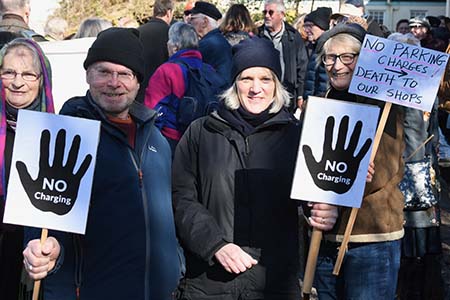
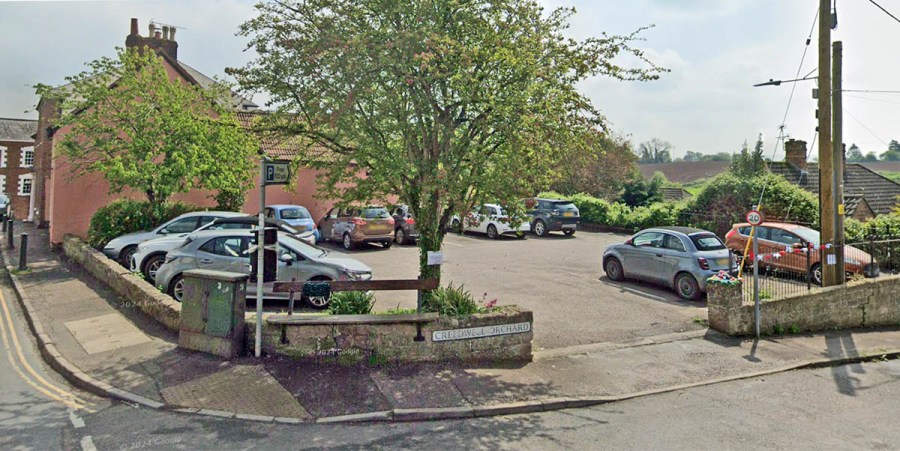
Protests against charging in free car parks was at its strongest in Wiveliscombe. A group of us quickly organised an event in Croft Way car park on Saturday, 1 March 2025, which was attended by about a 100 people. Our protest was well covered on regional ITV News, Somerset Leveller and in local papers, as well as in interviews on BBC Radio Somerset and 10 Radio.
Regretfully and following the Executive and full council decisions, new charges that are to be introduced throughout Somerset in October 2025 are:
Daily (8am – 6pm) charges of £2 in 39 free car parks, including Croft Way and North Street in Wiveliscombe and Fore Street in Milverton.
Charges on Sundays in all council car parks.
More charging in on-street parking bays in larger towns, which does not include Wiveliscombe.
A proposed evening and over-night charge has been dropped.
It is claimed this will result in a consistent approach to parking charges across Somerset, which avoids free parking being subsidised by those living in other areas. Additional income is also anticipated which it is estimated will raise about £1.5m per year for Somerset Council.
Consultation is to be undertaken, with details still to be confirmed. This now looks the best opportunity to raise and address problems that will result, although the budget commitment to the income could prove a barrier. The committee report says the “consultation provides an opportunity to address any concerns from business and residents”. We will see if this consultation proves to be meaningful.
Implementation costs are estimated at £250,000, which is to cover resurfacing, white lining, new signage and pay and display machines where needed. It is aimed to allow payment by cash, card or phone.
Additional staffing costs to implement and enforce the new charges are expected to be £236,400 per year, although there may be additional traffic wardens too who tend to be largely self-funding. Wardens do not have incentives to achieve targets or fine more drivers. They are only required to apply parking restrictions fairly to all. Fines can be challenged or appealed if needed.
Impacts and reducing problems
The Equalities Impact Assessment that accompanied the decision report was woeful. It suggested there would be no impact related to age, disability or rurality, and only said that “for some drivers there maybe a negative impact [from charges] where parking is currently free”. The council assessment also said: “public transport with bus fare caps remain as a cost effective option”. Buses are an option for some but are far from meeting the travel needs of all.
Oddly, the assessment said impacts would “be reconsidered as policy changes are proposed”. This doesn’t make much sense and seems wrong, as the assessment was accompanying a report that proposed policy changes and has lead to a council decision to introduce new charges!
The report to the scrutiny committee and executive contained nothing on economic impacts for shops and town centres. Many customers use the car parks but there was no assessment on whether their use may change.
In Wiveliscombe, both Croft Way and North Street car parks serve both nearby residents and the town centre including the shops. Both uses are important and need to be allowed to effectively continue.
There are more than 100 small houses and flats around the town centre without home parking. The only sensible parking options for most are the town’s two car parks. It can be seen that many using both car parks are local residents, including between 8am and 6pm.
It is inevitable that new parking charges will lead to many of the nearby residents looking to park at other locations, especially where allowed on-street. It is likely this would lead to more parking along Croft Way and North Street. It could lead to more parking too in Richard Beadon Close, Silver Street, South Street, West Street and West Road, and maybe in other nearby roads such as Market Place and Spring Gardens. There is little extra capacity for parking on any of these streets, and there are conflicts that already arise from the extensive parking that occurs on these roads, as well as in The Square at the centre of the town. These problems are likely to be made worse.
Residents may still use the car parks if affordable permits are available. However, permit costs are high in other Somerset towns. Permits cost £165 for 6 months or £220 per year in Dulverton, £300 for 6 months (£600 per year) in Wellington, and £770 for 6 months (£1,540 per year) in Taunton.
Another big issue is whether parking for shoppers will be made more difficult or easier due to less residential parking in the car parks. There could be a positive effect with more spaces available in car parks for those visiting to shop. Negative impacts could arise with more congestion from additional on-street parking around the town centre, and from new charges leading to shoppers going elsewhere where parking is free.
Shoppers would be encouraged to use the car parks by having free time-restricted spaces available or, less effectively, by lower parking charges for short stays, as in Dulverton (90p for up to an hour), Wellington (90p or £1.20 for up to an hour) and Taunton (£1.30, £1.40 or £1.60 for up to an hour).
Further concerns in Wiveliscombe are:
Wivey Link vehicles use Croft Way car park and have previously been unable to find alternative parking. The charity provides community transport for those without access to public or private transport and people who are sick or disabled, which will incur additional costs due to the parking charges. This imposition comes after Somerset Council withdrew grant funding for Wivey Link and other charities around Somerset.
Drivers avoiding the fees in Croft Way car park by mis-using the car park for the surgery and nursery opposite. This already occurs and can cause problems for those allowed or needing to park at the surgery or nursery.
More parents parking along North Street to drop off and collect their children at the primary school, instead of using the car park.
In Milverton, the small car park is mostly used by nearby residents. There are similar concerns to those in Wiveliscombe from cars being displaced to park on-street, where it would add to current congestion and potential parking conflicts. In addition, there are doubts on whether the income taken would cover the costs of the equipment and visits needed to collect the parking fees. Instead of raising an income for Somerset Council, charging in Milverton could be a net cost incurred by the council for no benefit.
Your concerns and ideas
I will be collecting evidence to contribute to the consultation on the parking charges in Wiveliscombe. A group are also doing so in Milverton and Wiveliscombe Town Council has set-up a working group. Please let me know how parking charges would impact you and if you have thoughts on how to reduce the negative impacts. Email me at: davem@wiveygp.org.uk
To assist with recovery following Covid lockdowns in 2021, funding was made available for projects to encourage people to return to town centres, including Wiveliscombe. Projects were led by local working groups involving councillors and business and community representatives.
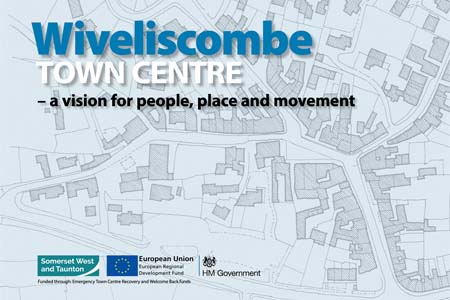
One of these projects aimed to leave a legacy by preparing a vision to enhance the sense of place, vitality and distinctiveness of Wiveliscombe Square and town centre. A project website details the local consultation undertaken (2021-22) and the final vision produced, which is summarised below. Unfortunately, it is now difficult to progress the larger elements of the vision, but there may still be some hope as outlined further below.
Other projects in Wiveliscombe included umbrellas for those in queues on rainy days (remember these during Covid?), flower and tree planting, a renewed town website, welcome banners, new benches, town centre maps and signs in car parks, graffiti removal, CCTV, contributions to Christmas lights and Community Centre building works, and painting street furniture.
Broadband connections in Upper Tone vary widely, due to improvements from new service roll-outs but also failures with the last two rounds of contracts awarded by Connecting Devon and Somerset. This has left some areas with ultrafast full-fibre networks provided by Airband, Gigaclear, Openreach or Technological. Others having superfast broadband with fibre to roadside cabinets. And large areas still left with only slow wire connections from local exchanges all the way to their properties.
This page provides details of current services in Upper Tone parishes and the town of Wiveliscombe, links to register interest in full-fibre broadband as networks expand, and information on alternative options (near the end), including wireless broadband on mobile networks.… Continue reading “Broadband networks”→
The general election on 4 July 2024 confirmed the country had enough of the Conservative (and coalition) governments which have caused much damage to the country and public services since 2010. The results also marked a big step forward for the Green Party.
Somerset Council can influence local energy consumption and generation, especially through planning policies in the Local Plan. I have called for work on this since 2019 when Somerset West and Taunton Council was established, and continued to push for it with the creation of the new Somerset Council.
Work was finally started in 2023 when contractors Regen were appointed to prepare a Somerset Energy Investment Plan. A Task and Finish Group was established to help shape and influence the plan. I was one of six councillors volunteering for this group and then selected as chair at the first meeting.
The task and finish group met from October 2023 to February 2024, and established a constructive dialogue with Regen on the plan’s content, recommendations and targets.
The completed Energy Plan and an accompanying Task and Finish Group report were presented to Climate and Place Scrutiny Committee on 20 March 2024 (item 57). The committee unanimously agreed to accept the group’s recommendations to the Executive, which will be the next step to be taken along the democratic path to adopt and implement the plan.
As reported, Somerset Council is in a financial crisis. Given the causes and the threat to important services (both outlined below), the government needs to provide more funding.
Next year’s local government financial settlement for 2024/25 will be announced in mid-December.
Services under threat
Internal controls and reviews have reduced Somerset Council’s budget gap for 2024/25 from £100m to £87m.
After seeing what government-appointed commissioners have done at other councils where bankruptcy has been declared (by issuing a section 114 notice), it is now proposed to take the same actions in Somerset to try to avoid a bankruptcy declaration here.
In addition to savings previously announced, a report, to be presented to the Executive on 6 December 2023, lists areas where service cuts and cost savings are now being sought in Somerset:
Efficiency savings including by reducing the use of consultants, selling council buildings, transforming IT infrastructure, reducing staff benefits and seeking external funding and grants.
Councillor costs reduced by having less meetings, fewer executive leads and less training.
Harmonising service standards to remove inconsistencies, such as the maintenance grants paid to parish and town councils in the former Somerset West and Taunton district (includes Upper Tone).
Increasing fees and charges including for parking, planning fees and collecting garden waste.
Adult social care spending reductions on some preventative services and reviews of fees and charges to reflect costs.
Children’s services reductions may include elements of early help, careers support and educational psychology support.
Community service reductions include CCTV, library services, leisure provision, management of parks and beaches, and support for theatres, visitor centres and heritage services.
Highways service levels reviewed including maintenance of ditches, grips, drains, gullies, grass and hedge cutting, weed treatment, road markings, signs and paths. Also reductions in support for active travel, (cycling and walking), school crossing patrols and community-based highways safety.
Public transport reductions in subsidies for buses, concessionary travel and park and ride.
Recycling centre closures, reduced hours and permits to restrict use to Somerset residents.
All deliverable savings may need to be taken, but this is still not expected to be enough to close the budget gap for 2024/25. In addition, it is expected to use reserves (then reduced to a minimum which is high risk) and to have government agreement to cover the rest of the revenue gap from sales of capital assets, such as council property (called capitalisation). Using reserves and capital to cover annual revenue costs just buys time, as once spent they are gone and cannot be used again.
Statement from the Green Party group on Somerset Council:
It is little surprise that Somerset Council is now facing a desperate and deepening financial crisis, with a real possibility of soon going bust. To begin with, the formula used for central government funding of councils is long out of date and needs completely overhauling. Somerset has a large population of over 580,000 people spread across a wide geographical area. It has a larger than average number of retired people, putting a strain on the Adult Services budget. Children’s Services has the additional demands of maintaining rural schools and providing transport for those who travel substantial distances to schools and colleges. These two services account for two-thirds of the council’s revenue budget. In addition, Somerset manages an enormous network of rural highways.
Over the last thirteen years of Conservative government, Somerset’s previous county and district councils have faced draconian cuts in funding from central government. With restrictive regulations on how much the council tax can be increased, the former County Council has previously embarked on a succession of “savings” in recent years, creating ever more pressure on staff and resources.
Somerset Council’s finances have looked grim for some months, but the picture suddenly looks far worse.
On 29 August 2023, a press release warned that the viability of the new council was at risk within two years due to the rising costs of social care.
Monthly finance briefings are held for councillors, when we have been told over some months of a budget gap of £100m to be closed over the next three years.
A point of crisis will come if the council cannot set a balanced budget or there is not a plan to control over-spending. The local authority equivalent of bankruptcy is issuing a Section 114 notice, which prevents spending on new commitments and can lead to commissioners being appointed by Government to run services within budget.
On 19 October 2023, Cllr Gwil Wren and I were asked to give a talk to the Wiveliscombe Civic and Historical Society about the new Somerset Council.
As explained below, a lot of progress has been made, but the new council is still settling in. The biggest issues relate to over-spending on social care and a £100m budget gap to close over the next three years.
Gwil and I presented a series of slides (click link to view) covering:
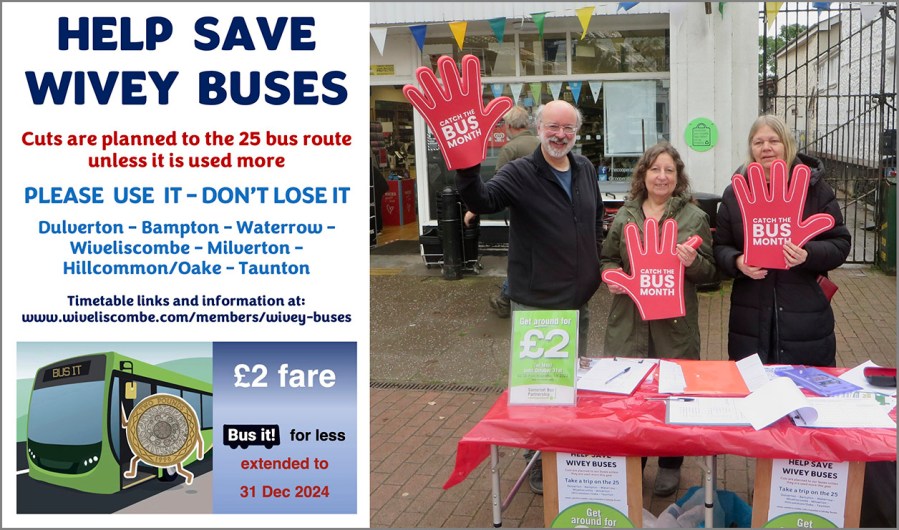
More passengers are needed to help save the 25 bus from cuts.
First Bus proposed service reductions from September 2023, which have been avoided, for now, by funding from Somerset Council to continue the current timetable until April 2024 (see updates on latest position below).
Wiveliscombe Bus User Group launched a campaign with posters and a stall in The Square on 16 September 2023, which attracted a lot of interest. Visit the group’s web-pages for links to timetables and access to bus tracking and also see the group’s Facebook page.
I support the bus user group and positive initiatives at the council. I also support ideas initially developed by Somerset Bus Partnership to allow a connection to Wellington and more frequent buses through Wiveliscombe and Milverton that connect to both Taunton and Wellington.
Somerset Council has now taken over from the county and district councils in Somerset. This big change was proposed by the County Council in 2020 during the pandemic. Government agreed, with consultation following and a Secretary of State decision in July 2021.
Elections to the new council were in May last year. Those of us then elected have served as county councillors for a year, as well as taking decisions on setting up the new council.
The County Council has been renamed as Somerset Council and the districts, including Somerset West and Taunton Council, merged in. The new council takes on responsibilities from both former tiers, which have always had overlaps. It should be beneficial and simpler to bring all together under one roof.
Work is progressing rapidly to establish the new Somerset Council from 1 April 2023, which merges the county council and four district authorities.
The vision, constitution and budget were agreed at a full meeting of the county council on 22 February, with votes on 1,140 pages of reports. These key documents developed as they progressed through committees and consultation over recent months. There were just a few final tweaks, along with questions and comments, at the meeting on the day.…Continue reading “Key documents for new council”→
A very late annual review this year. Elections in May kept me busy. After winning then, I now serve on both the county and district councils. Both are being reorganised to form a single new Somerset Council from April 2023, when Gwil Wren and I will continue as the unitary councillors for Upper Tone.
Below is my look back at council work over the last 12 months or so, and a look forward, with business increasingly dominated by local government reorganisation (again).
Despite the on-going challenges of Covid recovery, Brexit disruption, war in Ukraine with accompanying reductions in energy and food supplies, the ensuing cost of living crisis, and a badly misstepping government, some progress has been made by our councils; while some challenges faced have become worse, not least on budget restrictions and the need for effective action to halt global heating.
After the exciting promise of last year’s Bus Service Improvement Plan, the follow-up in 2022 has been disappointing, but there are still grounds for some hope.
Bad news is that bus use is still only 70% of pre-Covid levels, which has reduced revenue and led to timetable cuts by local bus companies in June. There may be further service reductions if current funding support from government ends next March, although timetable changes in June should have allowed for this to some extent and support could be further extended.
Some good news is that the County Council’s bid for government funding was one of only 31 bids to be successful (out of over 70); but instead of the £163m requested, just £12m was awarded.
The result for Upper Tone in the election on 5 May 2022 to Somerset County Council (one year) and to the new Somerset Council (from 2023) was:
Dave Mansell – Green (1,687 – 50%) – ELECTED
Gwil Wren – Independent (1,487 – 44%) – ELECTED
Roger Habgood – Conservative (1,158 – 34%)
James Hunt – Conservative (1,082 – 32%)
John Hassell – Liberal Democrat (641 – 19%)
Mike McGuffie – Labour (267 – 8%)
Philip Thorne – Independent (137 – 4%)
The total electorate was 7,625, who could vote to support two candidates, although a few only cast one of their two votes. The turnout for Upper Tone was 44.6%, which was above the overall turnout in Somerset of 37%.
Thanks for all the help and support given. Gwil and I will do our best as representatives for Upper Tone on the new council. I also look forward to working with four other Greens elected in Frome and with other councillors from around the county.
Along with Mark Blaker, I will continue for to be a district councillor for the Wiveliscombe and District ward on Somerset West and Taunton Council until April 2023. Then Gwil and I will continue as the unitary councillors for Upper Tone on the new Somerset Council that replaces the districts and county council.
Over my four years as a district councillor, I have done my best to represent Wiveliscombe and neighbouring parishes in my ward, to work with others and to be a positive Green voice on the Council.
Since 2018, I have helped with hundreds of local issues. I have spoken up at council meetings, read many reports and voted on their recommendations, sometimes proposing amendments. I have also sat on a number of working groups and delivery panels, and had monthly briefings on local climate change and ecological projects as the shadow portfolio holder.
The following are some highlights that have resulted from contributions I have made, often working with others.
WIVELISCOMBE AREA
Provided information on Covid support in the ward.
Installed the first public charging point for electric vehicles in Wiveliscombe, working with the Community Centre, Town Council and Brendon Energy. More council points have followed throughout the district, including in North Street car park.
Given support for funding to Wiveliscombe Community Centre, Town Hall Trust, Wiveliscombe Area Partnership, Wivey Pool, a new skate park at the Recreation Ground and to village halls.
Sought better progress on the local roll-out of full-fibre broadband and reported on new plans. I have met with Gigaclear, Connecting Devon and Somerset, and Airband, and organised a joint meeting for parish councils with Technological.
Sought improvements to town centre weeding and street cleaning, as well as to open spaces in car parks, which has included over-growth being cut back and more growing of wild flowers.
With a local steering group, supported town recovery projects with funding from Somerset West and Taunton Council. In particular, I helped arrange the painting of street furniture in The Square, updating of direction signs in Croft Way car park, and the cleaning of signs and removal of graffiti along the road into Wiveliscombe.
Proposed and chaired the place-making project group, which has organised consultation and is finalising a plan to improve The Square and traffic management in Wiveliscombe town centre – see update.
Proposed a budget amendment which led to more funding for climate and ecological projects.
Contributed to working groups on the Somerset climate emergency strategy and district action plans, which have been rated the best in the UK.
Challenged the council’s commercial investment strategy being debated in confidential sessions, which led to public debates and investment details being published on the council website.
Proposed and chaired a working group on retrofitting the council’s housing stock with insulation and zero carbon heating systems. Our report was passed by Scrutiny Committee (item minutes) and is currently proceeding on the democratic pathway to the Executive*.
As a member of Somerset Waste Board, supported the successful roll-out of Recycle More and called for more re-useprojects, which are to launched in the coming year.
Selected as vice-chair of Community Scrutiny Committee and so involved in scrutiny agenda setting and chairing some meetings.
At full council and committee meetings, I have voted to support many new projects and council initiatives, including: new development plans for the Firepool site in Taunton; the building of new council housing to a zero carbon design; accommodation and support for rough sleepers; pedestrianisation of East Street in Taunton; planning for new safe cycle routes; and many more.
* UPDATE (6/12/22): Following the retrofit working group report, which the Executive noted and asked officers to consider, a Low Carbon Retrofit Strategy and Delivery Plan for SWT’s council’s housing stock was prepared. After being considered by scrutiny committee and executive, it was adopted by full council and will be taken forward with the new Somerset Council. The retrofit strategy and plan are in line with a zero carbon future. The programme will proceed in stages, cost £135m over 28 years and sets the following targets:
2030 – All SWT homes to achieve EPC C or have an alternative investment option identified.
2040 – Aim to reduce heat demand on average from 135kWh/m2/yr to 50kWh/m2/yr through a ‘fabric first’ approach.
2050 – Replace fossil fuel in SWT homes with electric based heat and power at a pace to ensure affordable energy for tenants and in line with available funds. This does not prevent replacing fossil fuel with electric heat and power immediately where their heat demand is sufficiently low and funding is available.
Wasteology are applying for a low-level clinical waste incinerator at Greenham Quarry, near the A38, where they have existing waste operations. At this stage, the application is only on what to cover in an environmental assessment for the facility. This would be required for a future application for the plant itself, which has not yet been submitted, although there are details of what is proposed in the current application.…Continue reading “Incinerator proposed at Greenham”→